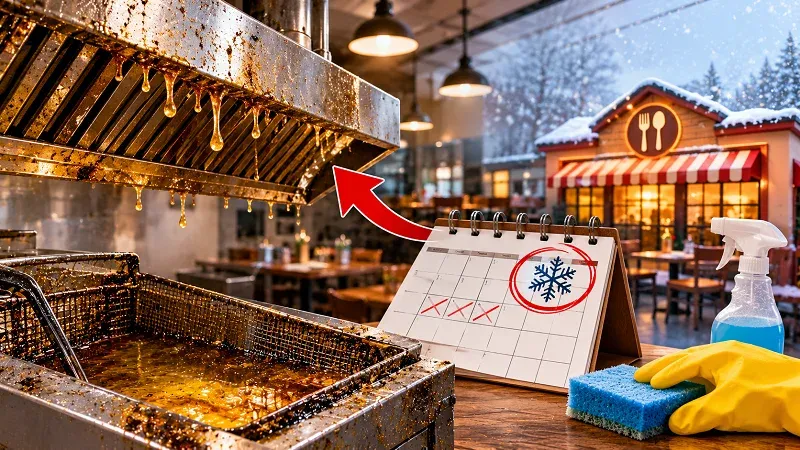
Every plumber who works on restaurants knows the December pattern. The kitchen is busier than at any point in the year, the menu is heavier, the dish pit never stops, and some time in the second week the floor drain by the fryers starts to back up. The call comes at 7 p.m. on a Friday. The line was not maintained in October because October was busy too, and it was not maintained in July because nothing was wrong in July.
Grease lines fail on a schedule, which means they can be maintained on one. Here is why December is the month, what is actually happening in the pipe, what it costs when it goes wrong, and the calendar that keeps a kitchen open through the holidays.
Grease trap, grease interceptor, grease line
The terms get mixed up, and the mix-up is why lines fail. They are three different things, serviced by two different trades.
| Part | What it is | Who services it | How often |
| Grease trap | A small unit under a sink or in the floor, 20 to 50 gallons, that catches fats, oils and grease before the drain | Kitchen staff clean it; a hauler or plumber pumps it | Weekly to monthly cleaning; pumped on a permit schedule |
| Grease interceptor | A large in-ground tank outside, 500 to 2,000 gallons, doing the same job for the whole kitchen | A licensed grease hauler pumps it | Typically every 30 to 90 days, per the city’s permit |
| Grease line | Every foot of pipe from each sink and floor drain to the trap or interceptor, and from there to the sewer | A plumber cleans and cameras it | Quarterly to twice a year, set from the camera |
Pumping the interceptor does nothing for the line. A kitchen with a perfectly serviced interceptor and a never-jetted line will still back up, because the line is where the grease that gets past the trap cools and sets. Many operators discover this distinction during their first December emergency, with the hauler’s invoice in hand as proof that “the grease was taken care of.”
What happens in the pipe
Hot, greasy water leaves the pot sink at well over 100°F. Within a few feet of horizontal pipe it cools below the point where fats stay dissolved, and the grease comes out of suspension and coats the pipe wall. Each shift adds a layer. Fryer oil, butter, cream sauces, meat fat from plate scraping and the emulsified grease that gets through the trap all contribute. The pipe’s diameter shrinks month by month until a surge from the dish machine or a floor wash cannot get through, and the lowest drain in the kitchen, usually a floor drain near the cook line, is where it comes back up.
December accelerates everything: more covers, heavier menus, more butter and cream, more water through the dish pit, often a kitchen staff that is partly new and less careful with scraping plates. A line that was at 60 percent of its diameter in October reaches zero in the busiest week of the year.
Why cabling fails in a kitchen
The emergency response is a cable machine, which bores a hole through the grease and gets the kitchen running within the hour. The lining stays on the pipe wall, the hole closes within weeks, and the kitchen is back on the phone before New Year. Cabling is the right emergency fix and the wrong maintenance plan.
Hydro jetting strips the pipe wall back to bare metal or plastic with water at 3,000 to 4,000 psi through a nozzle that cuts forward and flushes backward, and carries the debris to the interceptor, where the hauler collects it. A jetted line starts the busy season at full diameter. A camera afterward shows whether the pipe is sound or whether a section is bellied, scaled through or broken, which is common under older slabs. Commercial drain cleaning done this way costs more per visit than cabling and is needed far less often; across a year it is almost always the cheaper line on the budget, before counting a single lost service.
What a December backup costs
| Item | Emergency backup during service | Scheduled jetting in October |
| Plumber | After-hours emergency call, cabling, likely a return visit | One scheduled pre-opening visit |
| Service | Dish pit stopped, floor drain closed off, sometimes the kitchen closed for the night | None |
| Health department | Standing drain water on a kitchen floor is a critical violation if an inspector sees it | None |
| Staff | Overtime, cleanup, sanitizing | None |
| Recurrence | Likely within weeks, because the lining stayed | Unlikely until the next scheduled visit |
The exact figures vary by restaurant, but the shape does not: one Friday-night backup costs more than a year of scheduled jetting, and a closure during the holidays costs more than the whole maintenance budget.
The schedule
A kitchen that does not have December emergencies usually runs something like this:
| When | What |
| Quarterly | Jet the kitchen lines from the sinks and floor drains to the interceptor, scheduled before opening on the slowest weekday |
| October or early November | Jet everything, camera the main run, clear every cleanout, and confirm the interceptor pump-out is current before the holidays |
| Monthly | Staff check that floor drain strainers are in place and the trap under the pot sink is cleaned; a slow drain is reported the day it starts |
| Annually | Camera the line from the interceptor to the sewer, where roots and bellies hide, and review the jetting frequency |
| At any menu change toward heavier food, or a new concept in the space | Bring the next jetting forward |
Restaurants in Houston usually tie this to a service agreement so the dates are fixed and the visits happen outside service hours. A commercial plumber in Houston who works restaurants regularly will set the jetting frequency from what the camera shows, because a new PVC line in a strip-center kitchen and a cast iron line under a 1970s building are not the same pipe, and will keep the cleanout locations and the camera history on file so any technician can respond to an emergency without a tour.
Access: the part nobody budgets
Jetting a line needs a way into it. Kitchens built or renovated without thought for maintenance often have none: the only access is a floor drain with a strainer, or a cleanout buried behind a reach-in cooler, or nothing at all between the sinks and the interceptor. Every service visit then takes longer, and emergencies take longest.
The fix is cheap compared with what it saves: cleanouts at the end of each kitchen branch and at the point where the kitchen line leaves the building, kept accessible, with a two-way cleanout at the property line so the camera can look toward the city main when the backup is not the kitchen’s fault. A sewer cleanout installation is usually a single visit, and in a restaurant it is the difference between a twenty-minute jetting stop and a two-hour one.
What the staff can do
Half of the grease that reaches the line can be stopped at the sink. Three rules, posted in the dish pit and repeated at every new hire’s first shift:
- Scrape plates into the trash before the sink. A plate scraper by the dish machine costs nothing.
- Wipe pans and sheet trays before washing. Fryer oil and pan drippings never go down any drain; they go to the oil container for the hauler.
- Strainers stay in the floor drains. The person who pulls one to drain a mopped floor faster puts it back.
A fourth, for the manager: the trap under the pot sink is cleaned on a day that is written down, not when it smells.
Health inspections and the paper trail
Houston’s health inspectors look at drains. Standing water in a floor drain, a trap that has not been cleaned, or an interceptor without a current pump-out manifest are findings. A maintenance file with jetting dates, camera reports and hauler manifests answers most questions before they are asked, and it is also what a landlord or an insurer wants to see after a backup causes damage. Keep the plumber’s reports with the hauler’s manifests in one folder.
When the backup happens anyway
If a floor drain is backing up during service: stop the dish machine, stop running water in that section of the kitchen, move anything on the floor, and call. A floor drain backup is wastewater, and the health department’s view of a kitchen floor with standing drain water is not lenient. Most commercial plumbers will come during service for a backup because they know what is at stake; the visit is cheaper than closing for the night.
Afterwards, schedule the jetting. A kitchen that has backed up once will back up again on the same line unless the lining comes off, and the camera run while the line is clear shows whether the pipe underneath needs more than cleaning.
The owner’s checklist
- Know the difference: the hauler pumps the trap and interceptor; the plumber cleans and cameras the line.
- Jet quarterly, and always before the holidays.
- Camera the main run once a year.
- Make sure every branch has a reachable cleanout, and add a two-way at the property line.
- Post the three sink rules, supply the scrapers, and keep the strainers in.
- Put the dates in a contract so they happen when the kitchen is closed, and keep the reports with the hauler manifests.
From the trade
Royal Flush Affordable Plumbing, a Houston plumbing company that jets and maintains kitchen lines for restaurants across the city, sees the December calls every year from the same kind of kitchen: busy, well run, and never jetted. The ones that call in October do not call in December.